- English
- French
- German
- Portuguese
- Spanish
- Russian
- Japanese
- Korean
- Arabic
- Greek
- German
- Turkish
- Italian
- Danish
- Romanian
- Indonesian
- Czech
- Afrikaans
- Swedish
- Polish
- Basque
- Catalan
- Esperanto
- Hindi
- Lao
- Albanian
- Amharic
- Armenian
- Azerbaijani
- Belarusian
- Bengali
- Bosnian
- Bulgarian
- Cebuano
- Chichewa
- Corsican
- Croatian
- Dutch
- Estonian
- Filipino
- Finnish
- Frisian
- Galician
- Georgian
- Gujarati
- Haitian
- Hausa
- Hawaiian
- Hebrew
- Hmong
- Hungarian
- Icelandic
- Igbo
- Javanese
- Kannada
- Kazakh
- Khmer
- Kurdish
- Kyrgyz
- Latin
- Latvian
- Lithuanian
- Luxembou..
- Macedonian
- Malagasy
- Malay
- Malayalam
- Maltese
- Maori
- Marathi
- Mongolian
- Burmese
- Nepali
- Norwegian
- Pashto
- Persian
- Punjabi
- Serbian
- Sesotho
- Sinhala
- Slovak
- Slovenian
- Somali
- Samoan
- Scots Gaelic
- Shona
- Sindhi
- Sundanese
- Swahili
- Tajik
- Tamil
- Telugu
- Thai
- Ukrainian
- Urdu
- Uzbek
- Vietnamese
- Welsh
- Xhosa
- Yiddish
- Yoruba
- Zulu
EMV Card Personalization Production Management: Optimizing Resources with Advanced Tools
Getting emv card personalization right is one of the biggest problems that modern banks, payment service companies, and card makers have to deal with. As magnetic stripe technology for payment cards becomes less common, companies need to use more advanced production management methods that combine safety, compliance, speed, and cost-effectiveness. New, more advanced tools make it possible to encode chip data without any problems, insert secure keys, and personalize visually, all while meeting strict EMVCo and PCI DSS standards. Using these technologies to effectively optimize resources has a direct effect on business revenue and the time it takes to get new card programs on the market.
Understanding EMV Card Personalization and Its Production Challenges
Familiarizing yourself with EMV card personalization and the difficulties of making them is essential for any modern production facility. When magnetic stripe cards gave way to chip-enabled payment tools, it completely changed how cards are made. Modern chip card personalization has many complicated steps, such as adding cryptographic keys to secure elements, encoding application-specific data according to ISO/IEC 7816 standards, customizing the look of the card's surfaces, and controlling the activation process through server systems.
The Complexity Behind Secure Card Production
Workflows that aren't organized well in traditional production sites often cause problems. When you handle data by hand, you leave security holes that could let someone get to private user information or cryptographic materials without permission. Every link in the personalization chain needs to be carefully coordinated, from getting the data ready to checking the end quality. When systems aren't connected, they can cause problems that make wait times longer and cost more per card.
Common Bottlenecks in Traditional Environments
A lot of personalized companies and in-house card production centers have problems that keep coming up. Older machines often don't have the working speed needed for batch tasks with a lot of items. When quality checks are done by hand, mistakes can happen, and the process takes longer. Checking for compliance is hard to do without automatic check trails. When businesses grow to meet rising demand from digital banking projects or card portfolio growth, these errors get worse.
Security and Compliance Pressures
The rules that guide making payment cards are getting stricter all the time. Companies need to show that they follow the PCI DSS rules for safe key management, keep their EMVCo certifications up to date, and make sure that personalization facilities have the right access controls in place. Hardware Security Modules (HSMs) are now necessary parts, but setting them up in production processes is hard because of technology issues. Keeping up with constant compliance paperwork takes a lot of time and effort if you don't have the right tools.
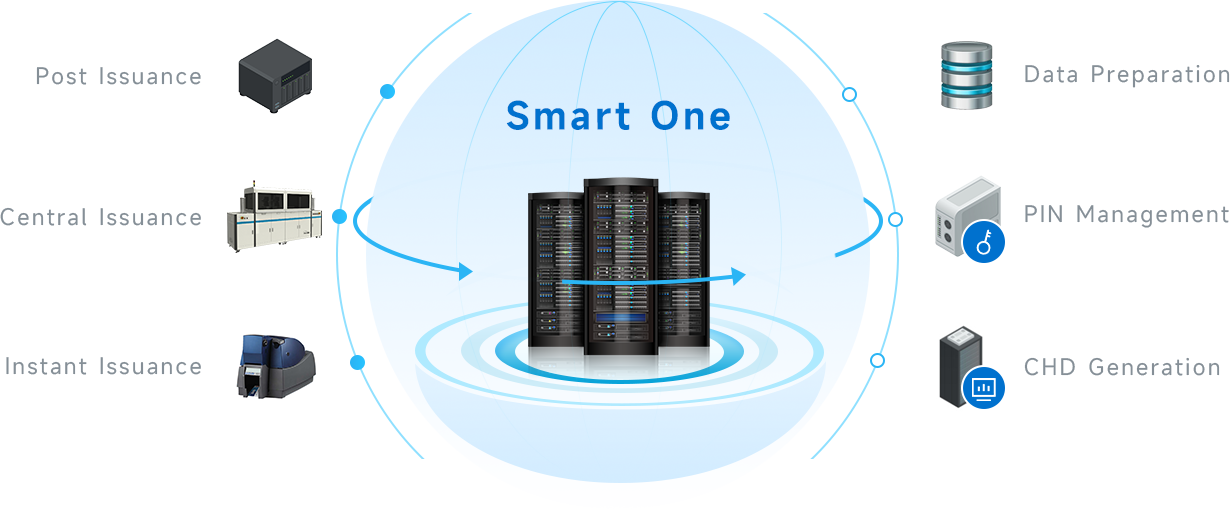
Advanced Tools Empowering EMV Card Personalization Production
EMV card personalization is enabled by advanced tools. New technologies have changed what can be done in card personalization creation in a big way. Modern systems mix advanced software with strong hardware interaction to make work much more efficient than ever before.
Software Platforms with AI-Driven Automation
Intelligent automation is used in modern personalization management systems to cut down on human work. These platforms can check new personalization data against business rules instantly, find formatting mistakes before production starts, and make the best job schedules based on available equipment and order priorities. Machine learning algorithms can figure out what maintenance needs to be done and find trends that could mean there are quality problems before they hurt production rates.
Through RESTful APIs and file-based interfaces, advanced software can connect to card management systems in real time. This connection makes sure that personalization data moves smoothly from platforms for giving to platforms for production, without having to be transferred by hand. Production managers can see every card's path through the personalization process at all times thanks to real-time progress tracking.
Hardware Integration for Speed and Accuracy
Modern tools for tailoring merge several tasks into a single production line. Stations that encode chips quickly can handle tens of thousands of cards an hour while still being 100% cryptographically correct. Laser etching systems make it possible to permanently and tamper-evidently add names and numbers to cards. Before leaving the production line, quality checking cameras make sure that every card meets certain visual standards.
Hardware Security Modules are the building blocks of safe key control. Payment keys are made, stored, and injected by these specialized cryptographic computers without letting general-purpose computing environments see them. When HSMs are properly connected to personalization software, they allow safe key injection at high production speeds without compromising security measures.
Comparing In-House Versus Outsourced Solutions
When it comes to personalization, organizations have to make smart choices. When you make something in-house, you have direct control over the processes, time, and security. When banks want to offer fast issuance, they often choose on-premise options that let personalization of cards at the branch level. This way, customers can leave with activated cards the same day. For these methods to work, you have to buy expensive tools and keep it in good shape.
By outsourcing personalization to specialized offices, you can get access to enterprise-level technology without having to pay for it all at once. Experienced offices can easily handle many clients, sharing the costs of infrastructure across a large amount of work. They stay up-to-date on their certifications and buy the newest tools. As a trade-off, you have to coordinate procedures and make sure that buildings owned by other people meet your security standards.
Step-by-Step EMV Card Personalization Production Optimization
To get practical success in card personalization, you need to carefully look at things and make plans for how to make them better in many areas. EMV card personalization step-by-step Production Improvement allows for significant gains in operational performance.
Assessing Current Performance Metrics
Start by making sure that your key performance measures are clear and represent the facts of production. Keep track of how many cards each personalization stand can process in an hour. Find out how many cards can be personalized without having to be reworked by measuring the first-pass return rate. Find out how long it usually takes from when you place an order to when you can sell it. Figure out how much it costs to make each card, taking into account workers, materials, machine wear and tear, and building overhead.
These standard measures show where waste is hiding. A lot of the time, production managers find that problems that seem small at first, like equipment calibration drift, bad job batching, or delays in data validation, have big effects over time that affect total performance.
Implementing Lean Manufacturing Principles
When it comes to personalization, lean methods work amazingly well. By showing each step of the production process in a flow chart, value stream mapping helps you see which tasks add value and which ones don't. A lot of places find that cards wait too long between steps in the process instead of being personalized.
Cellular production methods combine tools and tasks that are used together into single work cells. Instead of sending cards to different departments for chip encoding, magnetic stripe writing, and visual personalization, cellular layouts let one operator do several steps at once. This speeds up throughput, cuts down on handling, and makes responsibility obvious. KANBAN methods help keep track of the collection of work-in-progress, helping facilities avoid traffic jams and quickly find bottlenecks.
Real-World Efficiency Gains
A regional payment provider that works with neighborhood banks all over the Midwest had to deal with rising demand that made it hard for them to personalize payments. Their old systems needed data to be formatted by hand, equipment to work without being watched from a central location, and quality checks to happen only after whole runs of products were finished being made.
They made huge steps forward after putting in place a combined personalization management tool. Automated data checking got rid of layout mistakes that had to be fixed one at a time before. Real-time monitoring of tools let workers fix problems right away, instead of waiting hours to find out about them. With the same amount of tools, production rate went up by 40%. Costs per card went down by 28%, and quality measures got better. Lead times were cut from five work days to three, which let us respond to client requests more quickly.
How to Select the Right EMV Card Personalization Solution Provider
Picking the right technology partner has a big effect on your long-term success. Several important factors should be carefully looked at during the choosing process. EMV card personalization Solution Provider Selection Guide provides a structured approach to making this critical decision.
Evaluating Security Certifications and Standards Compliance
Check to see if any possible companies have up-to-date certifications from the payment systems and security groups that matter. Request proof of EMVCo approval for personalization systems, PCI DSS validation for facilities and processes, and ISO 9001 quality management qualifications. Don't just settle for promises of compliance. Security includes how things are done. Ask a lot of questions about how to handle keys, how to control access to personalization tools, and how to handle data.
Assessing Scalability and Technology Compatibility
Your needs for making cards will change over time. Check to see if possible answers can grow as the number of cases increases. Can the platform handle both centralized batch handling of a lot of documents and sites that issue documents right away? Does the design allow for adding more computers to increase capacity without having to completely rebuild the system? How well new personalization systems fit into current infrastructure depends on how well they can integrate with it through API docs and integration methods.
Understanding Total Cost and Support Models
Different companies have very different pricing systems. Some let you buy the equipment, while others would rather lease it, and service desk choices come with fees for processing each card. Instead of just looking at the original purchase costs, you should also look at the total cost of ownership over the expected lifespans. Support models have a huge impact on business stability. Make it clear what kinds of technical help are included and what kinds cost extra, including how long it takes for the company to respond to technical issues.
Why Industry Leaders Trust Wisecard Technology
Wisecard Technology's card personalization options are trusted by businesses all over the world because they are safe, quick, and reliable. We've set up personalization platforms in more than 60 countries and regions thanks to our more than 15 years of experience with banking payment systems. Our systems can handle both high-volume batch processing and instant issue, so they can be used with a variety of business methods. Right out of the box, our personalization solutions are totally compliant with EMVCo, ISO/IEC 7816, and PCI requirements, typically deploying within 10 to 30 days.
Streamlining EMV Card Personalization Order and Integration Process
Great personalization partners set themselves apart from average ones by having efficient order processes and seamless interaction. Knowing how a process usually works helps you set reasonable goals and find ways to make things better. EMV card personalization order and integration process made easier through modern technological partnerships.
Simplified Order Management from Inquiry to Delivery
Modern methods for personalization start with in-depth consultations to find out exactly what is needed. Producers talk about the different kinds of cards, how they want to be personalized, how many will be made, and when they expect them to be finished. Once everyone agrees on the requirements, the next important step is to integrate the data. Personalization systems need raw data that is properly organized and contains information about the user, card settings, and cryptographic materials. This way, mistakes are caught early, when they're easiest to fix.
Managing Customization and Bulk Orders
Standard card designs that need standard writing go through production without a hitch. Custom needs, like unique card artwork, special materials, or chip setups that aren't standard, need more planning. Customization is handled efficiently by experienced providers who have clear approval processes that check specs before production starts. Economies of scale help with bulk sales, but they need to be carefully planned. Dividing large orders into manageable groups ensures quality can be checked throughout production.
Post-Production Support and System Integration
Personalization doesn't end when the cards are made and sent out. Full solutions include coordinating card activation and connecting personalized cards to user accounts in systems that issue cards. Making and sending PINs need their own safe processes that work together with giving out cards. During the implementation phase, technical support helps with questions about integration and makes system settings better based on real-world experience. Partnerships that last a long time make sure that personalization options keep up with business needs.
Conclusion
The security, speed, and cost benefits of optimizing EMV card personalization production with advanced tools are quantifiable. Companies that use current personalization management tools have an edge over their competitors because they can get their products to market faster, make them cheaper per card, and make sure they are safer. The right technology base can be used with either centralized personalization offices or distributed instant issue networks. It can change to your unique way of doing business while still meeting strict compliance standards.
FAQ
How does EMV card personalization ensure payment security?
Personalization that is safe depends on many layers of security. Hardware Security Modules make and insert encryption keys without letting regular computers see them. End-to-end security keeps user data safe during all stages of production. Full audit logs keep track of all the times private data is accessed, making people responsible and letting them report on compliance. Physical security controls make it so that only authorized people can use production tools by limiting entry to personalization areas.
What factors influence EMV card personalization turnaround times?
Production schedules are affected by a number of factors. The number of orders has a direct effect on the schedule; bigger orders take longer to make but are more efficient because they are made in batches. It's important to keep customization simple; standard designs work faster than custom artwork or materials. Quality of the data affects speed; clean, correctly written input files go straight into production, while data that isn't working right needs to be fixed over and over again. When demand is higher than instant production capacity, delays can happen because of limited equipment and building space during busy times.
Can personalization systems accommodate diverse card program requirements?
Modern systems are very adaptable to meet the needs of a wide range of programs. They work with many kinds of cards, like debit, credit, prepaid, and dual-interface smart cards. Personalization settings are changed to work with different payment methods, local laws, and data patterns that are specific to the program. Customizing workflow lets different client programs that use shared technology have different quality control processes, approval processes, and paperwork standards.
Partner with an Experienced EMV Card Personalization Manufacturer
As a company with more than 15 years of experience in banking payment systems, Wisecard Technology offers enterprise-level personalized options. In more than 60 countries, our platform provides fully compliant chip encoding, safe key injection, and full lifecycle management to banks, card makers, fintech companies, and personalization offices. We offer quick deployment (10–30 days), seamless integration with current systems, and ongoing expert help to make sure that operations don't stop. Get in touch with us at inquiry@wisecardtech.com to talk about how our EMV card personalization tool can help your card distribution programs work better while cutting costs and speeding up delivery times.
References
Lopez, Maria and Chen, David. EMV Card Personalization: Security Protocols and Production Best Practices. International Journal of Payment Systems, 2022.
Thompson, Robert. Optimizing High-Volume Card Production Through Lean Manufacturing Principles. Financial Technology Press, 2021.
Anderson, Sarah et al. Compliance Requirements for Secure Payment Card Personalization Facilities. Payment Card Industry Security Standards Council, 2023.
Williams, James. Integration Strategies for Modern Card Management and Personalization Systems. Banking Technology Review, 2022.
Martinez, Carlos and Singh, Priya. Hardware Security Module Implementation in Card Production Environments. Journal of Payment Security, 2023.
Peterson, Linda. Cost-Benefit Analysis of In-House Versus Outsourced Card Personalization. Financial Services Operations Quarterly, 2021.
Learn about our latest products and discounts through SMS or email
_1778741495975.webp)