- English
- French
- German
- Portuguese
- Spanish
- Russian
- Japanese
- Korean
- Arabic
- Greek
- German
- Turkish
- Italian
- Danish
- Romanian
- Indonesian
- Czech
- Afrikaans
- Swedish
- Polish
- Basque
- Catalan
- Esperanto
- Hindi
- Lao
- Albanian
- Amharic
- Armenian
- Azerbaijani
- Belarusian
- Bengali
- Bosnian
- Bulgarian
- Cebuano
- Chichewa
- Corsican
- Croatian
- Dutch
- Estonian
- Filipino
- Finnish
- Frisian
- Galician
- Georgian
- Gujarati
- Haitian
- Hausa
- Hawaiian
- Hebrew
- Hmong
- Hungarian
- Icelandic
- Igbo
- Javanese
- Kannada
- Kazakh
- Khmer
- Kurdish
- Kyrgyz
- Latin
- Latvian
- Lithuanian
- Luxembou..
- Macedonian
- Malagasy
- Malay
- Malayalam
- Maltese
- Maori
- Marathi
- Mongolian
- Burmese
- Nepali
- Norwegian
- Pashto
- Persian
- Punjabi
- Serbian
- Sesotho
- Sinhala
- Slovak
- Slovenian
- Somali
- Samoan
- Scots Gaelic
- Shona
- Sindhi
- Sundanese
- Swahili
- Tajik
- Tamil
- Telugu
- Thai
- Ukrainian
- Urdu
- Uzbek
- Vietnamese
- Welsh
- Xhosa
- Yiddish
- Yoruba
- Zulu
EMV Fingerprint Cards vs Traditional EMV Cards: What's the Difference?
The primary difference between an EMV Fingerprint Card and a traditional emv card lies in authentication. Traditional EMV cards rely on chip technology combined with PINs or signatures to verify transactions. EMV fingerprint-enabled cards integrate a biometric sensor directly into the card body, replacing PINs with your unique fingerprint. This match-on-card technology stores your biometric template within the card's secure element, verifying identity locally without external databases. The result is faster, more secure transactions that eliminate PIN theft risks while maintaining full backward compatibility with existing payment infrastructure.
Introduction
Payment security has never been more critical in B2B procurement environments where transaction values routinely reach six or seven figures. EMV chip technology revolutionized card payments by encrypting data and reducing counterfeit fraud, yet vulnerabilities remain. PINs can be compromised through observation or data breaches. Signature verification offers minimal security in high-stakes financial transactions. As digital banks, payment service providers, and government agencies handle increasingly sensitive payments, the industry demands authentication methods that match the sophistication of modern threats.
Biometric authentication represents the natural evolution of payment security. EMV fingerprint cards combine proven chip technology with biometric verification, creating a two-factor authentication system embedded within a standard card form factor. This advancement addresses specific pain points in corporate procurement, utility billing systems, and financial institution operations where transaction integrity directly impacts operational continuity and regulatory compliance.
This comparison examines how fingerprint-enabled payment cards differ from traditional EMV solutions across security architecture, operational efficiency, and strategic implementation considerations relevant to procurement managers and technology integrators planning large-scale deployments.
1. Understanding EMV Fingerprint Cards and Traditional EMV Cards
1.1 Traditional EMV Card Architecture
Traditional EMV cards contain embedded microprocessor chips that store encrypted payment credentials and execute cryptographic operations during transactions. When inserted into a terminal, the chip communicates with the payment network to authenticate the card through dynamic data exchange. Cardholders verify their identity by entering a four-to-six-digit PIN or providing a signature. This chip-and-PIN system has been the global standard since the early 2000s, significantly reducing cloned card fraud compared to magnetic stripe technology.
The workflow follows a predictable pattern: card insertion, chip authentication, PIN entry, and transaction authorization. While effective against certain fraud types, this process creates vulnerabilities. PIN observation remains possible in crowded environments. Forgotten PINs lead to transaction failures and customer service calls. Shared corporate cards create accountability gaps since PIN knowledge doesn't prove which authorized user made a specific purchase.
1.2 EMV Fingerprint Card Innovation
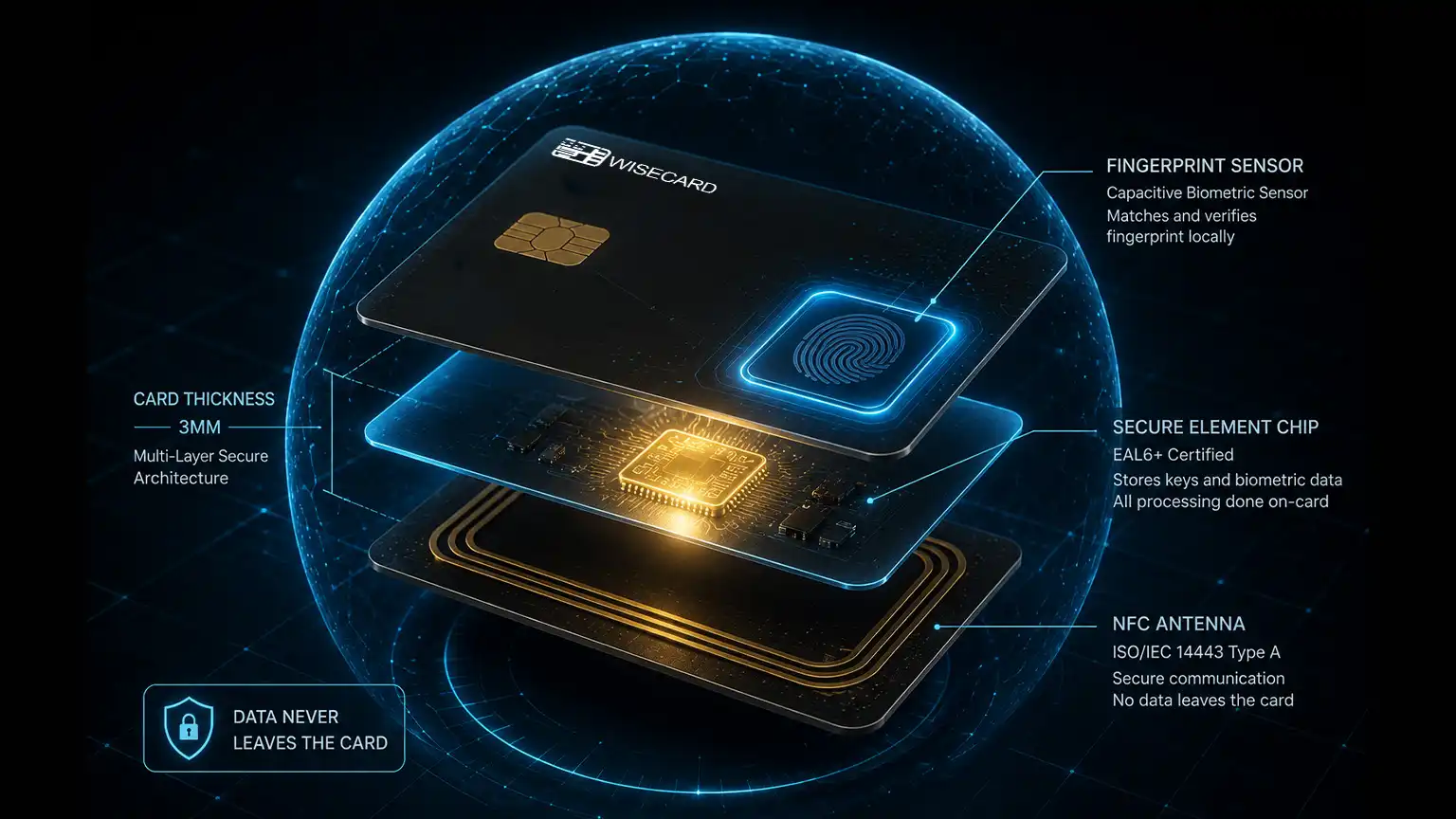
EMV fingerprint cards maintain full chip functionality while adding a miniature biometric sensor—typically a capacitive fingerprint reader measuring less than 50 micrometers thick. During card activation, you enroll your fingerprint directly onto the card using a secure reader or specialized mobile app. The card generates and stores your biometric template within its secure element, never transmitting this sensitive data externally.
Transaction workflows change fundamentally. You present the card to a terminal as usual, but instead of entering a PIN, you simply rest your finger on the embedded sensor. The card performs on-card matching, comparing your live fingerprint against the stored template in milliseconds. Authentication happens locally within the card itself. Once verified, the chip proceeds with standard EMV transaction protocols. The terminal receives only confirmation that authentication succeeded, never accessing your actual biometric data.
This architecture delivers privacy advantages that centralized biometric systems cannot match. Your fingerprint never enters payment networks or merchant databases. The card draws power from the terminal's electromagnetic field through energy harvesting technology, eliminating battery requirements while maintaining the standard 0.76mm card thickness that fits existing wallets and card slots.
2. Key Differences Between EMV Fingerprint Cards and Traditional EMV Cards
2.1 Security Enhancement and Fraud Prevention
Biometric authentication fundamentally changes the security equation. Your fingerprint cannot be forgotten, written down, or shared—eliminating the most common PIN-related vulnerabilities. Advanced sensors achieve false acceptance rates below 1 in 50,000, meaning unauthorized access becomes statistically improbable even if cards are lost or stolen. Comparing this to PIN systems where a four-digit code offers only 10,000 possible combinations, the security improvement becomes clear.
Card-present fraud scenarios change dramatically. Stolen traditional EMV cards remain usable if the thief knows or guesses the PIN. Stolen biometric cards become worthless without the legitimate cardholder's fingerprint. This matters particularly in B2B environments where corporate cards may be targeted specifically for their higher transaction limits. Financial institutions deploying these cards report measurable reductions in fraud-related chargebacks and liability costs.
The local authentication model also protects against network-level attacks. Because biometric verification occurs entirely within the card's secure element, intercepting transaction data yields no useful authentication credentials. Payment networks receive only encrypted authorization requests identical to traditional EMV transactions, maintaining end-to-end security without requiring infrastructure changes.
2.2 User Experience and Transaction Efficiency
EMV Fingerprint Card technology significantly improves transaction speed. Biometric verification completes in under one second compared to the several seconds required for PIN entry, particularly when cardholders hesitate or enter incorrect codes. In high-volume payment environments like utility service centers or government payment windows, these seconds compound into significant efficiency gains. Our deployment data from financial institutions shows average transaction times decrease by 15-30% when switching to fingerprint authentication.
The convenience factor extends beyond speed. Elderly customers or those managing multiple payment cards no longer struggle with password recall. Corporate users appreciate the seamless experience during business travel or procurement activities. Contactless payment limits—typically capped at modest amounts for traditional cards—can be safely increased or removed entirely since biometric verification provides strong authentication regardless of transaction value.
Accessibility considerations also improve. Unlike PINs that require visual confirmation or keypad familiarity, fingerprint authentication works intuitively across diverse user populations. This universality proves valuable for government social benefit programs and telecom service providers serving broad demographic groups with varying technical comfort levels.
2.3 Integration and Infrastructure Compatibility
Backward compatibility represents a crucial advantage for large-scale deployments. EMV fingerprint cards function as standard chip cards at terminals that haven't been updated with biometric capability. At older ATMs or payment terminals, cardholders can complete transactions using traditional PIN entry as a fallback method. This dual-mode operation protects your infrastructure investment while enabling gradual migration to fully biometric authentication.
Terminal upgrades follow straightforward paths. Existing contactless NFC terminals already provide the electromagnetic field that powers the card's biometric sensor through energy harvesting. Payment terminals require only firmware updates to recognize and process biometric authentication confirmations—no hardware modifications necessary. This reduces deployment costs significantly compared to authentication methods requiring entirely new terminal ecosystems.
System integrators appreciate the EMVCo certification that ensures global interoperability. Cards manufactured to these specifications work seamlessly across Visa, Mastercard, and other major payment networks. Backend payment switches and card management systems process biometric card transactions through existing EMV protocols, requiring minimal modifications to established infrastructure. We have successfully deployed these solutions across 60+ countries without encountering fundamental compatibility barriers.
3. Why Choose EMV Fingerprint Cards? Business Benefits and Use Cases
3.1 Securing High-Value Corporate Transactions
Financial institutions adopting EMV fingerprint card solutions can address unique corporate authentication challenges. Traditional corporate cards often have elevated transaction limits to accommodate business procurement needs, making them attractive fraud targets. Biometric authentication addresses this directly by ensuring only authorized cardholders can complete transactions regardless of amount.
Consider procurement scenarios in manufacturing or technology sectors where purchase orders regularly exceed $50,000. Traditional contactless limits would require PIN entry for these amounts, creating opportunities for observation or coercion. Fingerprint authentication removes this vulnerability while maintaining transaction speed. The enhanced security justifies premium card programs that generate higher interchange revenue while reducing fraud liability exposure.
Banks and credit unions report that VIP banking clients view biometric cards as tangible demonstrations of institutional commitment to security and innovation. These cards become relationship tools that reinforce client confidence during wealth management and private banking interactions. The exclusivity factor differentiates card programs in competitive markets where traditional features have reached parity.
3.2 Customization for Brand Differentiation
OEM manufacturing capabilities enable complete card personalization. Financial institutions can specify sensor placement, card materials, printing techniques, and chip configurations that align with brand identity and technical requirements. Custom designs communicate innovation while maintaining the professional aesthetics expected in premium card programs.
Bulk-ordering economics become favorable at enterprise scale. Production runs accommodate specific security policies, integration requirements, and regulatory compliance needs across different markets. Digital banks launching new card products can differentiate through biometric features that traditional competitors cannot quickly replicate. Telecom operators bundling payment capabilities with mobile services gain competitive advantages through exclusive authentication technology.
Payment service providers and fintech companies particularly benefit from customization flexibility. These organizations often require API integration, specialized SDK support, and rapid deployment capabilities that standard products cannot address. Our development team collaborates directly with integrators to configure cards matching specific platform architectures and user authentication workflows.
3.3 Operational Efficiency in Public Service Deployments
Government agencies administering benefit distribution programs face persistent challenges with identity verification and fraud prevention. Traditional card programs experience "ghost beneficiary" problems where stolen or borrowed cards allow unauthorized individuals to access funds. Biometric authentication eliminates this vulnerability by verifying the legitimate recipient at every transaction point.
Transportation systems implementing smart city payment infrastructure benefit similarly. Transit cards using fingerprint authentication prevent unauthorized sharing while maintaining passenger flow efficiency. The technology supports seamless integration with existing fare collection systems and citizen ID programs, creating unified platforms for public service access.
Utility companies deploying self-service payment kiosks reduce fraud and operational costs simultaneously. Customers complete bill payments using biometric verification without staff intervention, while the utility gains assurance that payments originate from authorized account holders. This reduces disputed charge resolutions and improves customer satisfaction through faster, more convenient service interactions.
4. How to Select the Right EMV Fingerprint Card Supplier
4.1 Certification and Technical Credibility
Supplier evaluation begins with certification verification. ISO/IEC 7810 compliance ensures physical card specifications meet global standards for dimensions and durability. PCI certification confirms data security measures throughout manufacturing and personalization processes. EMVCo approval guarantees interoperability with major payment networks and terminal infrastructure. These certifications represent extensive testing and continuous compliance monitoring—not merely marketing claims.
Manufacturing expertise matters significantly in biometric card production. The integration of ultra-thin sensors, secure elements, and energy harvesting modules within standard card thickness demands specialized capabilities. Suppliers should demonstrate established production lines with quality control processes that ensure consistent sensor performance and card reliability across large batches. We maintain rigorous testing protocols where each card undergoes multiple verification phases before shipment.
Technical support infrastructure determines long-term success. Suppliers must provide comprehensive assistance from initial specification development through deployment and ongoing operations. This includes API documentation for system integration, SDK support for custom applications, and responsive technical teams capable of addressing issues across global time zones. Our support model includes both remote and on-site assistance to ensure deployment success regardless of complexity.
4.2 Cost Considerations and Value Assessment
Upfront pricing naturally exceeds traditional EMV cards due to integrated biometric components and sophisticated manufacturing. However, total cost of ownership analysis reveals different economics. Reduced fraud losses, decreased customer service costs from forgotten PINs, and improved transaction efficiency generate measurable returns. Banks typically observe positive ROI within 18-24 months when deploying biometric cards for premium segments.
Bulk ordering enables favorable pricing structures for enterprise deployments. Production efficiencies at scale reduce per-unit costs while customization options remain available. Long-term value extends through warranty coverage, replacement policies, and supplier stability that ensures continued support throughout product lifecycles. Procurement managers should evaluate supplier financial health and market presence to mitigate risks of discontinued support.
Delivery timelines impact deployment planning significantly. Standard card inventory enables rapid fulfillment for pilot programs or urgent requirements. Custom manufacturing typically requires 10-30 days depending on specifications and order volumes. Suppliers demonstrating flexible production scheduling and reliable logistics become valuable partners for staged rollouts across multiple regions or customer segments.
5. Future Trends of EMV Fingerprint Card Technology
5.1 Multi-Modal Biometric Authentication
The next evolution of EMV fingerprint card technology incorporates multi-modal biometric authentication. Research prototypes combine fingerprint sensors with facial recognition or iris scanning capabilities, creating multi-factor authentication that adapts to transaction risk levels. High-value corporate transactions might require both fingerprint and facial verification, while routine purchases are complete with a fingerprint alone. This flexibility enables risk-based authentication strategies aligned with fraud prevention objectives.
Behavioral biometrics represent another frontier. Cards may eventually analyze grip patterns or interaction timing to create additional authentication layers that operate invisibly during normal use. These passive authentication methods complement active biometric verification, making fraud attempts increasingly difficult without degrading user experience.
Integration with mobile ecosystems continues advancing. Near-field communication enables cards to interact with smartphones for enrollment, authentication, and transaction monitoring. This creates unified digital identity platforms where physical cards, mobile wallets, and online accounts operate cohesively under consistent biometric authentication frameworks.
5.2 Regulatory Evolution and Market Growth
Payment card industry standards are evolving to accommodate biometric authentication formally. Regulatory bodies worldwide are developing frameworks that recognize biometric verification as strong customer authentication under financial security regulations. This regulatory clarity accelerates institutional adoption by providing compliance certainty for banks and payment processors.
Market projections indicate substantial growth in biometric payment card adoption. Industry analysts forecast compound annual growth exceeding 40% through 2028 as production costs decline and deployment case studies demonstrate measurable benefits. Government agencies, financial institutions, and corporate payment programs represent the most significant growth segments as these organizations prioritize transaction security and operational efficiency.
Privacy regulations simultaneously shape technology development. GDPR in Europe, CCPA in California, and emerging data protection laws globally mandate strict controls over biometric data handling. Match-on-Card architecture directly addresses these requirements by ensuring biometric information never leaves the physical card, simplifying compliance compared to centralized biometric systems that create regulatory exposure.
5.3 Strategic Procurement Implications
Technology procurement decisions made today determine organizational security posture for years ahead. Payment authentication represents foundational infrastructure that touches every financial transaction. Selecting suppliers with long-term viability, continuous innovation capabilities, and global support networks protects these investments against premature obsolescence.
Procurement managers should evaluate supplier roadmaps for emerging authentication technologies and integration capabilities with evolving payment ecosystems. Vendors demonstrating active participation in industry standards development and payment network certification programs signal commitment to sustained innovation. This becomes particularly important as digital identity frameworks converge across payment, access control, and online authentication domains.
Risk management strategies should incorporate biometric authentication as a core control rather than optional enhancement. The technology has matured beyond experimental status into proven solutions deployed across diverse markets and use cases. Organizations delaying adoption face increasing competitive disadvantage as security-conscious customers and regulatory bodies expect stronger authentication standards.
Conclusion
EMV fingerprint cards represent a fundamental advancement in payment authentication, replacing knowledge-based PINs with biometric verification that cannot be forgotten, stolen, or shared. The technology delivers measurable security improvements, operational efficiencies, and user experience enhancements while maintaining complete compatibility with existing payment infrastructure. Financial institutions, government agencies, payment service providers, and corporate procurement programs gain tangible benefits through reduced fraud, streamlined transactions, and differentiated service offerings. As regulatory frameworks evolve and production costs decline, biometric authentication is transitioning from a premium feature to an expected standard across payment card programs worldwide.
FAQ
What makes EMV fingerprint cards more secure than traditional chip cards?
Biometric authentication verifies the physical presence of the legitimate cardholder at every transaction. Unlike PINs that can be observed, guessed, or obtained through data breaches, your fingerprint is unique and cannot be replicated. The Match-on-Card architecture stores your biometric template exclusively within the card's secure element, ensuring your fingerprint data never enters payment networks or merchant systems where it might be compromised.
Will these cards work with our current payment terminals?
Yes, full backward compatibility ensures operation across existing infrastructure. At terminals supporting biometric authentication, cardholders use fingerprint verification. At older terminals, the cards function as standard chip cards using PIN entry. Contactless terminals require only firmware updates to recognize biometric authentication, eliminating expensive hardware replacement costs.
How do we handle minimum order quantities for enterprise deployment?
Bulk ordering accommodates enterprise requirements with flexible minimum quantities based on deployment scope. Pilot programs can proceed with smaller batches while large-scale rollouts benefit from volume pricing. Production scheduling adapts to phased implementation timelines, allowing organizations to validate technology and user acceptance before committing to full deployment volumes across all customer segments.
Partner with a Trusted EMV Fingerprint Card Manufacturer
Wisecard Technology delivers comprehensive biometric payment solutions backed by 15+ years of specialized expertise in banking payment systems and card technologies. Our EMV fingerprint cards meet rigorous ISO, PCI, and EMVCo certifications while offering complete customization capabilities to match your specific institutional requirements and brand identity. We support your deployment from initial consultation through production, integration, and ongoing technical assistance across 60+ global markets.
Whether you're launching premium credit card programs, securing corporate payment infrastructure, or implementing government benefit distribution systems, our manufacturing capabilities and technical support ensure successful implementation. Contact our team at inquiry@wisecardtech.com to discuss your specifications, receive detailed technical documentation, and explore customized solutions for your biometric payment card needs. As a leading EMV fingerprint card supplier, we deliver enterprise-grade security combined with seamless integration support that transforms your payment authentication strategy.
References
1. EMVCo Technical Specifications for Biometric Payment Cards, 2022 Edition, EMVCo Standards Body.
2. Biometric Authentication in Payment Systems: Security Analysis and Implementation Guidelines, Journal of Financial Technology Research, 2023.
3. Global Payment Card Security Report: Fraud Trends and Authentication Technologies, Payment Security Consortium, 2023.
4. ISO/IEC 7810 Identification Cards Physical Characteristics Standards, International Organization for Standardization, 2019.
5. Match-on-Card Technology: Privacy-Preserving Biometric Authentication Architecture, International Biometric Security Conference Proceedings, 2022.
6. Market Analysis: Biometric Payment Cards Adoption Trends in Financial Institutions, Financial Technology Market Research, 2024.
Learn about our latest products and discounts through SMS or email
_1778741495975.webp)