- English
- French
- German
- Portuguese
- Spanish
- Russian
- Japanese
- Korean
- Arabic
- Greek
- German
- Turkish
- Italian
- Danish
- Romanian
- Indonesian
- Czech
- Afrikaans
- Swedish
- Polish
- Basque
- Catalan
- Esperanto
- Hindi
- Lao
- Albanian
- Amharic
- Armenian
- Azerbaijani
- Belarusian
- Bengali
- Bosnian
- Bulgarian
- Cebuano
- Chichewa
- Corsican
- Croatian
- Dutch
- Estonian
- Filipino
- Finnish
- Frisian
- Galician
- Georgian
- Gujarati
- Haitian
- Hausa
- Hawaiian
- Hebrew
- Hmong
- Hungarian
- Icelandic
- Igbo
- Javanese
- Kannada
- Kazakh
- Khmer
- Kurdish
- Kyrgyz
- Latin
- Latvian
- Lithuanian
- Luxembou..
- Macedonian
- Malagasy
- Malay
- Malayalam
- Maltese
- Maori
- Marathi
- Mongolian
- Burmese
- Nepali
- Norwegian
- Pashto
- Persian
- Punjabi
- Serbian
- Sesotho
- Sinhala
- Slovak
- Slovenian
- Somali
- Samoan
- Scots Gaelic
- Shona
- Sindhi
- Sundanese
- Swahili
- Tajik
- Tamil
- Telugu
- Thai
- Ukrainian
- Urdu
- Uzbek
- Vietnamese
- Welsh
- Xhosa
- Yiddish
- Yoruba
- Zulu
Anvor vs Other Smart Rings: What Sets It Apart for B2B Partners
Financial companies and payment service providers need to know what makes Anvor different from other wearable payment devices when they are looking at smart ring options for business usage. We at Wisecard Technology have seen how this new payment ring combines contactless transactions with biometric health tracking, giving B2B partners in the banking, fintech, government, and payment infrastructure sectors a unique value offering. Anvor offers enterprise-level security standards along with flexible customization options that meet the needs of large-scale rollout partners looking for scalable, compliant payment solutions. This is in contrast to consumer-focused alternatives that only focus on fitness tracking.
1. The Smart Ring Competitive Landscape Overview
1.1 Market Shift Toward Enterprise-Grade Wearable Payment Solutions
In the past few years, the market for portable payment technology has changed a lot. It used to be just fitness trackers, but now it includes more complex financial tools. A number of companies make smart bands that can be used for payments, but most of them are aimed at consumers rather than businesses.
Most traditional smart rings focus on health data, tracking sleep, or simple NFC features. The strict security standards that banks and payment service providers demand are rarely met by these consumer-focused gadgets. Many consumer goods still don't meet regulatory standards like EMV approval and PCI DSS compliance, which makes it harder for financial institutions to integrate wearable payment systems.
1.2 Enterprise Requirements vs Consumer Features
Financial companies and payment service providers need very different requirements than regular customers. Banks need to be able to integrate back-end systems, have security policies that can be changed, and have approval paperwork that shows they are following international payment standards. Credit unions and digital banks need to make sure that the way they protect transaction data meets the strict standards set by regulators.
In our 15 years of experience building payment systems, Wisecard Technology has seen this gap. The gap between what consumer products can do and what businesses need for adoption opens the door for solutions designed especially for institutional partners. Smart ring makers who want to work with businesses need to take care of things like compliance certification, API documents, scaling testing, and long-term technical support promises that consumer brands don't usually think about.
2. Anvor's Dual Positioning: Payment Plus Health Monitoring
Anvor is different from other devices because it is designed to be used for two different things at the same time. This smart ring doesn't just advertise itself as a payment device or a health gadget; it combines the two functions into a single platform that is meant to be used in institutions.

2.1 Contactless Payment Infrastructure
Anvor's payment core works with most contactless transaction protocols, so it can be used with point-of-sale systems that banks and payment companies already have. This flexibility means that financial institutions that are looking into wearable payment methods don't have to spend as much on infrastructure.
For transaction protection, normal banking protocols are used, along with encryption standards that are in line with EMV requirements. Because Anvor is focused on compliance, it can be used in test projects in regulated financial settings, where experimental consumer devices would be rejected right away during security checks.
2.2 Biometric Health Data Capabilities
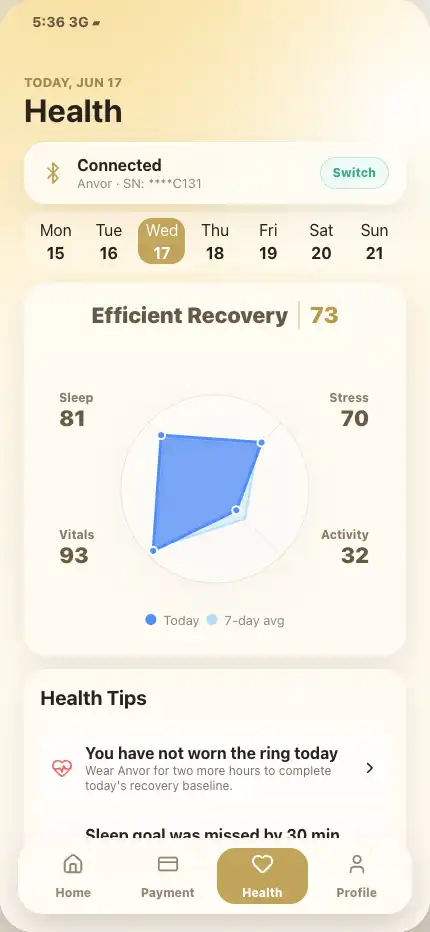
In addition to letting you pay, Anvor has biometric devices that track your heart rate and exercise levels. Health tracking may not seem related to financial services, but this dual ability opens the door to a number of B2B uses.
Government transit agencies that build smart city facilities can use programs that mix payment and health for citizens. Integrated systems that do more than just accept bill payments help telecom companies that offer value-added services stand out. When banks create customer loyalty programs, health incentives that are tied to transaction accounts are a creative way to get people to participate.
The part that monitors health works separately from the part that handles payments, keeping different data lines that follow privacy rules for financial information. This design split is very important for banks to meet customer protection standards in a number of different regulatory areas.
3. Payment Network Compatibility Advantages
3.1 Interoperability as the Foundation of Institutional Payment Adoption
Interoperability is what makes a payment system successful or unsuccessful when it comes to getting institutions to use it. Financial companies can't use solutions that need their own computer infrastructure or that require expensive system upgrades on networks that are already in place.
When building Anvor, cooperation with well-known payment rails is a top priority. The gadget works perfectly with the contactless payment systems that Mastercard and Visa already have set up in millions of stores. This wide flexibility gets rid of the "chicken-and-egg" problem that comes up with new payment technologies that need their own acceptance systems before they can handle a significant number of transactions.
3.2 Multi-Channel Transaction Processing Support
Payment service providers with a wide range of clients need options that are flexible enough to handle all kinds of transactions. Anvor's platform design allows for integration across many channels, such as standard retail point-of-sale settings, fare collection systems for public transportation, and stations for paying for utilities.
Standardized standards make it easier for system integrators to get certified when they set up payment acceptance facilities in different areas. Technology distributors don't have to deal with different integration needs for each rollout situation. Instead, they can use uniform API documentation and SDK tools that speed up time-to-market across a range of vertical apps.
The backend payment solutions from Wisecard Technology work with Anvor's frontend features to make an end-to-end infrastructure that supports systems for issuing cards, moving transactions, and handling settlements. When banks and payment processors look at new payment tools, they look at all of their customers' needs. This unified method meets all of those needs.
4. Design and Material Flexibility
The ability to customize has a big effect on institutional adoption choices. Instead of generic gadgets that make banking more like any other experience, banks want unique payment tools that strengthen relationships with customers.
4.1 Customizable Form Factors
Anvor lets you change the settings in a lot of different ways. The choice of materials includes long-lasting ceramics that work well in high-wear areas and high-end metals that are good for wealthy customers. Banks can make unique product variations that follow brand identity rules by using different color choices, sizes, and surface finishing methods.
This tailoring goes beyond just how something looks and includes useful requirements. For government projects that need to make public transportation uses last longer, ruggedized building parameters can be used. Fintech businesses that want to attract younger customers can make their products as light and comfortable as possible to wear for long amounts of time.
4.2 White-Label and Co-Branding Opportunities
Banks' card-issuing systems usually support co-branded credit cards that make relationships with stores, airlines, and hotel chains stronger. When makers allow large-scale customization, wearable payment gadgets also offer co-branding possibilities.
Financial institutions can use Anvor under their own brand name, which keeps customer ties strong instead of adding third-party names to the payment process. This white-label feature is especially helpful for digital banks that want to stand out in the market by giving unique products.
Technology wholesalers who work with a lot of clients in different regions can save time and money by standardizing platforms underneath customized surface presentations. While the outward branding changes to meet the needs of different customer groups and areas, the payment handling technology stays the same.
5. Strategic Value for Issuers and Distribution Partners
B2B partners look at more than just the technical details of new payment systems. They also look at how well they fit with long-term business goals. Adoption choices are affected by the chance of making more money, getting customers more involved, and standing out from the competition.
5.1 Revenue and Engagement Opportunities
Fintech competitors and non-bank payment companies are making banks' jobs harder. Innovative payment tools make it possible to get users back who might otherwise leave for other financial service providers. Wearable payments are especially appealing to people who grew up with technology and that standard banks have a hard time reaching with their regular products.
Transaction data from smart tech gives us clues about how customers usually act, which helps us make new products and plan our marketing campaigns. Privacy laws limit how data can be used in the right way, but pooled analytics help banks figure out how people use their data and find ways to offer extra services that go well with their current ones.
To set their platforms apart from others, payment service companies can offer new form factors in addition to cards and mobile wallets. When clients are looking for a payment company, they expect more and more complete omnichannel support that includes wearable devices as well as traditional payment methods.
5.2 Scalability and Support Infrastructure
Pilot projects show that ideas are possible, but institutional partners need to be sure that the solutions will work for a lot of customers. Decisions about deployment are based on things like the ability to manufacture, the quality assurance procedures, and the technical support skills.
Wisecard Technology takes care of the production machinery that helps more than 60 countries and regions use their cards. This well-established operating presence gives users peace of mind that Anvor will be available to meet their growing program needs. When banks start using wearable payments, they need makers that can handle everything from test programs to full portfolio rollouts without sacrificing quality or delivery times.
Another important thing to think about is technical help. System designers that are setting up payment systems need tech resources that can respond quickly to integration problems, update documentation, and quickly fix problems in the field. For a relationship to last, both parties must be willing to keep supporting each other after the original product delivery.
Conclusion
Anvor stands out in the market for smart rings by making design decisions that are meant to meet the needs of business usage rather than just following consumer market trends. Its value offering is in line with the needs of banks, payment service providers, government agencies, and technology distributors because it works with multiple payment networks, is focused on compliance, can track health, and can be customized in a number of ways. As the use of wearable payments grows, institutional partners can benefit from solutions that are designed to be scalable and legal in a wide range of practical settings. Anvor is a unique choice for B2B partners looking at next-generation payment tools because it can be used for two different purposes, is already integrated with payment rails, and can be customized with different brands.
FAQ
What makes Anvor suitable for bank deployment compared to consumer smart rings?
Anvor uses PCI DSS security protocols and EMV compliance guidelines that most consumer products don't have. Back-end integration with card-issuing systems and payment handling technology that banks need is possible with this platform. Customization features allow for branded deployment under the names of financial institutions instead of bringing in third-party consumer brands into interactions with customers.
How does Anvor integrate with existing payment infrastructure?
The gadget works with standard contactless payment systems that are already in use by many store networks, so there's no need for any special acceptance infrastructure. Backend payment platforms, card management systems, and transaction switching networks that banks and payment service providers run can be integrated with the help of API documentation and SDK tools.
Can government transportation projects customize Anvor for specific applications?
Material requirements, durability factors, and useful configurations can be changed to fit different deployment situations. Authorities in charge of public transportation can choose ruggedized designs that can handle heavy public use while still working with fare collection systems and the need to integrate citizen IDs that are common in smart city infrastructure projects.
Partner with Wisecard: Your Anvor Supplier for Enterprise Payment Solutions
Wisecard Technology has been developing payment systems, card issue platforms, and banking terminal solutions for more than 15 years and has worked with clients in more than 60 countries. As a manufacturer and integration partner for Anvor with a lot of experience, we offer full help from the initial meeting through rollout and ongoing technical support. Our team knows that institutional payment projects are different from individual apps because they have to follow rules, be scalable, and need to be customized. If you work for a bank looking into wearable payment channels, a system developer building regional infrastructure, or a government body putting in place smart city payment systems, we'd love to talk to you about how Anvor can meet your needs. Get in touch with our team at inquiry@wisecardtech.com to talk about relationship possibilities and find out how our payment innovation solutions can help your business and the people you serve.
References
1. Anderson, M. & Williams, R. (2023). "Wearable Payment Technology Adoption in Financial Services: Enterprise Perspectives and Implementation Challenges." Journal of Financial Technology Innovation, Volume 12, Issue 3.
2. European Payment Council (2022). " Contactless Payment Security Standards: EMV Compliance Requirements for Alternative Form Factors." EPC Industry Report on Payment Innovation.
3. Global Payment Infrastructure Association (2023). "Smart Wearables in Banking: Strategic Considerations for Institutional Deployment." GPIA Annual Technology Assessment.
4. Thompson, J. (2023). "Payment Terminal Compatibility and Network Interoperability: Technical Requirements for Wearable Financial Devices." International Journal of Payment Systems, Volume 8.
5. United States Federal Reserve (2022). "Alternative Payment Instruments and Consumer Protection: Regulatory Framework for Emerging Technologies." Federal Reserve Payment Innovation Research Paper Series.
6. Zhang, L. & Kumar, S. (2023). "B2B Payment Technology Partnerships: Evaluation Criteria for Financial Institution Vendor Selection." Banking Technology Quarterly, Spring Edition.
Learn about our latest products and discounts through SMS or email
_1778741495975.webp)